Detection
Detection predicts cell or nucleus centroids and classes in a tile. A frozen encoder supplies dense grids, a decoder predicts per-class heatmaps, and the detection head extracts points and scores them at matching distance δ. It shares dense extraction and caching with Segmentation.
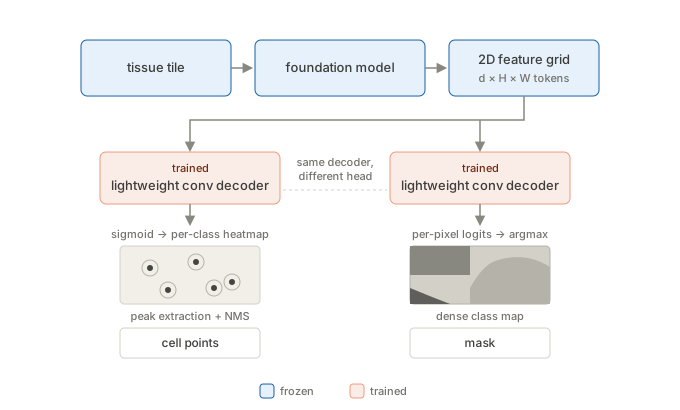
Detection extracts heatmap peaks; segmentation selects a class per pixel. Both use the same decoder architecture, trained for their respective task.
The use-case table names the end-to-end scenarios that run this path on a small synthetic dataset.
The method
The decoder output passes through a sigmoid to give one heatmap in [0, 1]
per object class; background is the absence of a peak. The training target is a
peak Gaussian rendered at each annotated point (peak value 1, overlaps
merged by element-wise max, not a count-preserving density map), and the
loss is foreground-weighted MSE. At inference, the head recovers peaks per
channel by local maxima + NMS and keeps every peak above min_score. A
per-class score threshold, chosen on the tune split, then selects the
points that are matched to ground truth with class-aware F1@δ.
Data contract
A detection head reads its supervision through
soma.data.AnnotationManifest and soma.data.PointSource. The
supervision is a per-sample point file, not a scalar label or a mask.
Column |
Required |
Meaning |
|---|---|---|
|
yes |
Filename-safe id (cache key). |
|
yes |
Tile / ROI image. |
|
yes |
Per-sample point annotations. |
|
no |
Finite positive µm/px declaration for the source image’s level-0 pixels. Required for flat PNG/JPEG extraction; WSI readers may resolve it from the slide. |
|
no |
Region with no annotation. See Ignore masks. |
|
no |
Parent slide id and tile origin, retained as metadata. |
|
no |
Optional; supervision is the points. |
The points_path file is CSV with x, y, class columns (a headerless
x,y,class — OCELOT’s format — or a 2-column single-class x,y is also accepted).
The class column holds the dataset’s own annotated ids; Classes
says which ids form which class.
Classes
learner:
  params:
    head:
      name: detection
      params:
        classes: {mnl: [0, 1]}
        drop: [2]
classes names each class and the annotated id(s) that form it; several ids
merge into one class, which gets one heatmap channel. The class index is the
declaration order and the names are stored with the predictions. The ids need
not be 0-based: a dataset annotated with
{1, 2} can be declared as classes: {background_cell: [1], tumor_cell: [2]}.
drop lists the annotated ids to discard. A dropped point leaves the
supervised set: it is absent from the target heatmap and from the ground truth
used for matching. Its location is therefore negative supervision, and a
prediction there counts as a false positive. To mark a region as not annotated
instead, use an ignore mask.
An id belongs to one class or to drop; listing it twice is a config error. A
point file holding an id declared in neither fails the run and names the sample.
The class scheme is not part of the feature cache key: regrouping classes reuses
the cached features. num_classes is derived from classes. Point files
that already hold 0-based class indices may set num_classes alone.
Ignore masks
Point-annotated datasets often label only part of each image, for example the
cells inside annotated ROI polygons. The optional ignore_mask_path column
marks the pixels that are not annotated, so that the model is neither trained
nor scored there.
Format. A flat, single-channel uint8 PNG in the image’s own (level-0) pixel
frame. 255 means “not annotated” and 0 means “supervised”, as with
segmentation’s ignore_index. Any other value fails the run with an error
that names the file and the sample. A sample without a mask is supervised
everywhere.
Semantics. Ignored pixels are “don’t care”:
Loss. The loss is averaged over the supervised pixels only, so the prediction on an ignored pixel does not change it. Without a mask the loss is unchanged.
Ground truth. Points on ignored pixels are removed from the target heatmap and from the ground truth used for matching. A point is removed when its level-0 pixel is ignored, or when its pixel in the
target_sizeframe is ignored.Predictions. Peaks on ignored pixels are left out whenever predictions are scored: in the threshold sweep, in evaluation and in the detection benchmark. The saved predictions file keeps them.
Area. The FROC per-mm² area of a sample (
soma.benchmark.monkey.froc) covers its supervised pixels only.
The mask is mapped to the run’s target_size frame like the points: each
target pixel takes the value of its nearest level-0 pixel.
Tiling. When an ROI row of the manifest given to
python -m soma.benchmark.tiles has ignore_mask_path, the mask
must have the size of the ROI image. The tiler then:
pads the mask with 255 where it pads the ROI up to a full tile;
crops the mask for each tile to
ignore_masks/<tile_id>.pngand sets the tile row’signore_mask_path;skips tiles with no supervised pixel;
writes no point on ignored pixels to a tile, and counts these points in
summary.jsonaspoints_in_ignored_region;writes
roi_valid_area_px, the ROI’s supervised pixel count (padding excluded), on every tile row. The stitched ROI area for FROC uses it.
Without the column, the tiler output does not change.
Coordinate convention — level-0 store, target compute
Points are stored in the source image’s level-0 pixels. The loader maps them
into the run’s target_size frame for encoding and matching:
x_target = x_level0 * (source_spacing_um / effective_spacing_um) - crop_left
y_target = y_level0 * (source_spacing_um / effective_spacing_um) - crop_top
Both spacings come from each dense artifact’s slide2vec sidecar;
effective_spacing_um can differ slightly from
the requested features.dense.spacing_um when a WSI reader accepts a nearby native
level. Predicted points are written back to the source frame in the predictions
file.
Configuration
features:
  encoder: { name: uni }
  dense:
    target_size: 1024                  # supervision tile size
    spacing_um: 0.2                    # requested read scale; sidecar records effective scale
learner:
  name: dense
  params:
    decoder:                           # the heatmap regressor
      name: lightweight_conv
    head:
      name: detection
      params:
        classes: {background_cell: [0], tumor_cell: [1]}   # OCELOT, as curated by soma
        match_distance: 3.0            # δ, in µm (OCELOT's 15 px at 0.2 µm/px)
        sigma: 1.0                     # target Gaussian σ in µm (default ≈ δ/3)
        matching: hungarian            # hungarian (default) | greedy (OCELOT-official)
        foreground_weight: 10.0        # MSE up-weight on near-peak pixels
evaluation:
  metrics: [mean_f1, f1_per_class]
match_distance (δ) is required. sigma defaults to δ/3 and
nms_distance to δ. All three are specified in µm and converted to pixels
using each grid’s persisted effective_spacing_um. Samples may have different
source spacings, but a run requires one effective spacing and uniform grid
geometry.
The head’s other parameters are:
min_score(default0.01): the lowest peak score the head emits. Keep it low; the operating threshold is chosen afterwards on the predictions.validation_threshold(default0.5): the fixed peak threshold of the validation metrics computed during training, which drive checkpoint selection and early stopping.foreground_weight(default10): the MSE up-weight on near-peak pixels.matching:hungarian(default) orgreedy, used for training-time validation and for scoring.classes/drop: the class scheme; see Classes.
Detection also runs with features.kind: live, which re-encodes the tiles
at every step, and can then augment them with loaders.augment; see
Live re-encoding and augmentation.
The default feature kind is patch_features. To probe attention maps with
the same head, loss, and evaluator, use an attention-capable encoder and set:
features:
  dense:
    feature_kind: cls_attention
    attention_blocks: [-1]
    attention_include_registers: false
Attention maps retain the token-grid resolution; switching feature kind does not add spatial samples. See Decoders for the trained decoders.
To score the attention itself as the heatmap, with nothing trained, use the
attention_map decoder. It averages the attention heads (reduction: max
takes their maximum), or only those listed in heads, and min-max normalises
the map of each tile. Every class gets the same map. The run trains nothing but
still chooses its peak threshold on the tune split:
learner:
  name: dense
  params:
    decoder:
      name: attention_map
      params: {heads: null}   # [k] scores head k alone
attention_map registers with the benchmark package (soma.benchmark),
which the soma CLI imports.
Metric — F1 at matching distance δ
Predicted points are matched to ground truth per class (a prediction only matches a
same-class GT within δ) using optimal one-to-one Hungarian assignment (default) or
greedy-by-confidence (matching: greedy, OCELOT’s official scorer — emit it for a
leaderboard-comparable number). Matched pairs are TP, unmatched predictions FP,
unmatched GT FN.
Score threshold — the pipeline sweeps one threshold per class on the tune predictions to maximise F1 (
soma.evaluation.sweep_threshold()withper_class=True) and applies it unchanged to every test split (no test leakage). A run without a tune split (cohort.allow_missing_tune) scores atvalidation_thresholdinstead: train stands in for tune there, and a sweep on the training samples would pick an in-sample cut.Aggregation — the headline
mean_f1is dataset-global (counts pooled per class → one F1 per class → mean across classes, OCELOT-faithful).mean_f1_per_imageis available as a secondary (per-image macro). Per-class F1 / precision / recall are exposed viaf1_per_class/precision/recall.
Outputs
Each fold writes metrics.json (tune + per test split) and
predictions_<split>.parquet for tune and every test split. The predictions
are a PointPredictions with columns
sample_id, x, y, class, score in level-0 coordinates; class is the class
index. They hold every peak above min_score, before any threshold, so a
different threshold or matching rule can be applied later without rerunning
inference (see Segmentation and detection predictions). Point overlays and raw heatmaps are
optional; see Run outputs.
Task head
- class soma.models.heads.detection.DetectionHead(*, num_classes, geometry, spacing_um, match_distance, sigma=None, nms_distance=None, min_score=0.01, validation_threshold=0.5, foreground_weight=10.0, matching='hungarian', truncate=3.0, metrics=None, class_names=None)
Bases:
TaskHeadDense peak-heatmap detection head (parameter-free; the decoder learns).
- Parameters:
num_classes (
int) – Number of object classesC(one heatmap channel each; background is the absence of a peak).geometry – The run’s
GridGeometry:encoded_sizeandcrop_boxfor the logits, and the level-0 anchor (origin, level-0 pixels per frame pixel) mapping point annotations into the frame.spacing_um (
float) – µm/px of the frame the heatmap lives in (the grid’s effective spacing); converts the µm distances below to frame pixels.match_distance (
float) – F1 matching distance δ in µm.sigma (
float|None) – Target Gaussian σ in µm (default δ/3).nms_distance (
float|None) – NMS / local-maxima radius in µm (default δ, so two detections cannot both satisfy one ground-truth point).min_score (
float) – Floor on the peakspostprocess()emits. Keep it low: thresholds are chosen afterwards on the predictions.validation_threshold (
float) – Fixed peak threshold of the training-time validation metrics (dense_stats).foreground_weight (
float) – Up-weights the MSE on near-peak target pixels to fight the background imbalance; per-pixel weight1 + fw * target.matching (
str) –"hungarian"(optimal one-to-one) or"greedy"(by confidence, OCELOT-official); the training-time validation matcher and the default the pipeline scores with.truncate (
float) – Render each target Gaussian withintruncate * sigma.metrics (
list[str] |None) – Metric names (validated against thedetectionfamily).class_names (
Sequence[str] |None) – One name per class index, carried by the predictions.