Aggregators
Aggregators combine a slide’s tile features into a representation for
multiple-instance learning (MIL). Select a preset as the mil learner’s
aggregator leaf: learner.params.aggregator.name in YAML, {"aggregator":
"abmil"} (or {"name": ..., "params": ...}) in the Python
LearnerConfig. Patient-level pipelines use a frozen patient encoder instead.
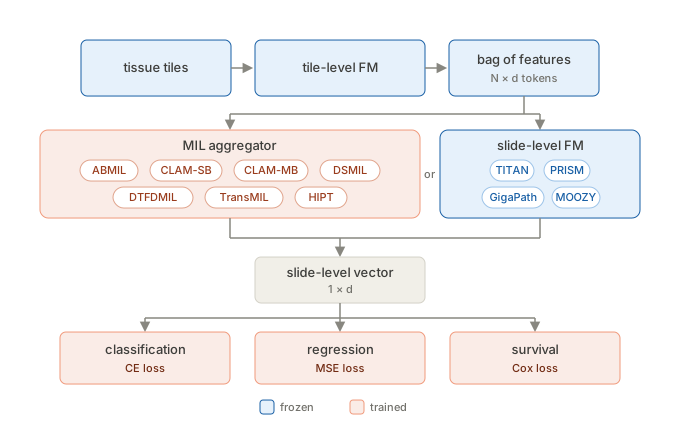
A trained MIL aggregator pools the bag of tile features into one slide-level vector.
Aggregator Zoo
Preset |
Description |
Notes |
|---|---|---|
|
Mean over all tile features. |
|
|
Element-wise max over tile features. |
|
|
Gated attention pooling for slide-level aggregation. |
Ilse et al., 2018 |
|
Single-branch CLAM with instance-level supervision. |
Lu et al., 2021 |
|
Multi-branch CLAM with one attention branch per class. |
Lu et al., 2021 |
|
Dual-stream MIL with a critical-instance query. |
Li et al., 2021 |
|
Two-tier MIL with pseudo-bag distillation. |
Zhang et al., 2022 |
|
Transformer-based MIL with Nystrom attention. |
Shao et al., 2021 |
|
Hierarchical image pyramid transformer. |
Chen et al., 2022 |
Aggregator details
ABMIL
abmil returns tile-level attention scores for heatmap generation.
- class soma.models.aggregators.mil.abmil.ABMIL(input_dim, hidden_dim=128, activation='tanh', gated=True, dropout=0.25)
Bases:
AggregatorAttention-Based MIL aggregator.
Uses gated attention pooling to aggregate tile features into a slide-level representation, with per-tile attention weights for interpretability and heatmap generation.
- Parameters:
input_dim (
int) – Feature dimension of input tiles.hidden_dim (
int) – Attention bottleneck dimension.activation (
str) – Activation function (‘tanh’, ‘relu’, ‘gelu’).gated (
bool) – If True, use gated attention.dropout (
float) – Dropout rate applied before attention.
CLAM-SB
clam_sb supports binary, multiclass, ordinal, and single-target regression
tasks, and can mix bag-level and instance-level supervision.
- class soma.models.aggregators.mil.clam.CLAM_SB(input_dim, hidden_dim=512, attn_dim=256, gated=True, dropout=0.0, k_sample=8, n_classes=2, inst_loss='ce', use_negative_class_instance_loss=False, bag_weight=0.7, instance_loss_mode=None, low_attention_weight=0.1, topk_target_weight=1.0)
Bases:
_CLAMBaseSingle-branch CLAM aggregator.
CLAM-MB
clam_mb requires multiclass_classification.
- class soma.models.aggregators.mil.clam.CLAM_MB(input_dim, hidden_dim=512, attn_dim=256, gated=True, dropout=0.0, k_sample=8, n_classes=2, inst_loss='ce', use_negative_class_instance_loss=False, bag_weight=0.7)
Bases:
_CLAMBaseMulti-branch CLAM aggregator.
DSMIL
dsmil requires binary_classification.
- class soma.models.aggregators.mil.dsmil.DSMIL(input_dim, att_dim=128, nonlinear_q=False, nonlinear_v=False, dropout=0.0)
Bases:
AggregatorDual-Stream MIL aggregator.
Uses an instance classifier to identify a critical instance, then computes attention via query-key matching with the critical instance.
- Parameters:
input_dim (
int) – Feature dimension of input tiles.att_dim (
int) – Attention/query dimension.nonlinear_q (
bool) – If True, use nonlinear query projection.nonlinear_v (
bool) – If True, use nonlinear value projection.dropout (
float) – Dropout rate for value projection (when nonlinear_v=True).
DTFDMIL
instances_per_group (default 1) sets how many instances each pseudo-bag
contributes; the partition is random during training and contiguous in eval mode.
- class soma.models.aggregators.mil.dtfdmil.DTFDMIL(input_dim, embed_dim=512, hidden_dim=128, n_groups=8, distill_mode='maxmin', instances_per_group=1, dropout=0.25)
Bases:
AggregatorDouble-Tier Feature Distillation MIL aggregator.
- Parameters:
input_dim (
int) – Feature dimension of input tiles.embed_dim (
int) – Width of the learned tile embedding every later step works in (the reference’sDimReductiontomDim= 512). Without it, pseudo-bag pooling, CAM scoring and distillation all act on frozen encoder features, and the default max-min distillation fails to learn even a task where one marker tile decides the label.hidden_dim (
int) – Attention bottleneck dimension.n_groups (
int) – Number of pseudo-bags to partition into.distill_mode (
str) – Feature distillation mode (‘maxmin’, ‘max’, ‘afs’).instances_per_group (
int) – Instances distilled per pseudo-bag and per direction (‘max’ keeps the top-k CAM instances, ‘maxmin’ the top-k and bottom-k). The reference implementation usestotal_instance // numGroup= 1; clamped to the pseudo-bag size.dropout (
float) – Dropout rate applied before tier-1 attention.
The pseudo-bag partition is a random permutation drawn from torch’s global RNG while the module is in training mode (so it follows the run seed and differs every step, as in the reference), and a deterministic contiguous split in eval mode so scoring a checkpoint is reproducible.
TransMIL
- class soma.models.aggregators.mil.transmil.TransMIL(input_dim, att_dim=512, n_layers=2, n_heads=4, n_landmarks=None, pinv_iterations=6, dropout=0.0, use_mlp=False)
Bases:
AggregatorTransformer-based Correlated MIL aggregator.
Uses Nystromformer layers with PPEG positional encoding and a learnable class token to aggregate tile features.
- Parameters:
input_dim (
int) – Feature dimension of input tiles.att_dim (
int) – Transformer embedding dimension.n_layers (
int) – Number of Nystromformer layers (must be >= 2).n_heads (
int) – Number of attention heads.n_landmarks (
int|None) – Landmarks for Nystrom approximation (default: att_dim//2).pinv_iterations (
int) – Pseudo-inverse iterations.dropout (
float) – Dropout rate.use_mlp (
bool) – Whether to use MLP blocks in transformer layers.
HIPT
hipt assumes hierarchical tiling; its tile_multiple param (or
features.extraction.region_tile_multiple) controls how many tiles fit along
each side of a region.
- class soma.models.aggregators.mil.hipt.HIPT(input_dim, region_size, patch_size, embed_dim_region=192, embed_dim_slide=192, num_heads=6, dropout=0.25)
Bases:
AggregatorHierarchical Image Pyramid Transformer aggregator (Chen et al., 2022).
Two-level hierarchy: a region-level ViT aggregates P tile features per region, then a global transformer + gated attention pools M region embeddings into a slide-level representation.
Features are stored either flat as
(B, N, D)whereN = M × P, or natively hierarchical as(B, M, P, D)whereP = (region_size / patch_size)². HIPT reshapes internally.- Parameters:
input_dim (
int) – Feature dimension of input tiles (auto-resolved from CachedSetSource).region_size (
int) – Region pixel size (e.g. 4096). Required.patch_size (
int) – Subtile pixel size within region (e.g. 256). Required.embed_dim_region (
int) – Region ViT output dimension.embed_dim_slide (
int) – Global transformer / output dimension.num_heads (
int) – Attention heads in region ViT.dropout (
float) – Dropout rate.
Aggregator interface
The shared base classes are soma.models.aggregators.base.Aggregator and
soma.models.aggregators.base.AggregatorOutput.
- class soma.models.aggregators.base.Aggregator(*args, **kwargs)
Bases:
ABC,ModuleAbstract base class for MIL aggregators.
Consumes a bag of tile features (B, N, D) and produces a slide-level representation (B, D_out) wrapped in an AggregatorOutput.
- class soma.models.aggregators.base.AggregatorOutput(bag_representation, tile_attention=None, auxiliary=None)
Bases:
objectStructured output from an aggregator.
- bag_representation
Slide-level representation, shape (B, D_out).
- tile_attention
Per-tile attention weights, shape (B, N). None for non-attention methods (e.g. MeanPool, MaxPool).
- auxiliary
Optional dict of auxiliary tensors for training-time losses (e.g. instance logits for DSMIL, embeddings for CLAM).
soma.components("aggregators") lists the registered aggregators with their
params and defaults.